

Learn how to get traffic to your print-on-demand store in 2026 with Pinterest, Etsy SEO, Shopify SEO, Google, social media and free marketing strategies.
Introduction: How to Get Traffic to Your Print-on-Demand Store (2026)
Getting visitors to a print-on-demand (POD) store is one of the biggest challenges for new sellers. You may have attractive designs, quality products and a well-designed online shop, but without targeted traffic, generating sales can be difficult.
The good news is that you don’t need an enormous advertising budget to attract potential customers. With the right combination of search engine optimization (SEO), Pinterest marketing, social media content, marketplace optimization and useful content, you can gradually build a consistent source of visitors.
Whether you sell through Etsy, Shopify, WooCommerce or another print-on-demand platform, this guide explains practical ways to attract relevant visitors and turn more of them into customers.
Instead of chasing random views, the goal is to reach people who are already interested in the products you sell.

1. Why Traffic Matters for a Print-on-Demand Business
Print-on-demand allows entrepreneurs to sell customized products without purchasing inventory in advance. Products are manufactured and shipped by a fulfillment provider after a customer places an order.
However, having products available online does not automatically bring customers.
Think of your POD store as a physical shop located on a quiet street. Even if the products are excellent, people cannot purchase them if they never discover the shop.
Online traffic creates opportunities for potential customers to:
- Discover your products.
- Explore your designs and collections.
- Compare prices and product features.
- Learn about your brand.
- Make purchasing decisions.
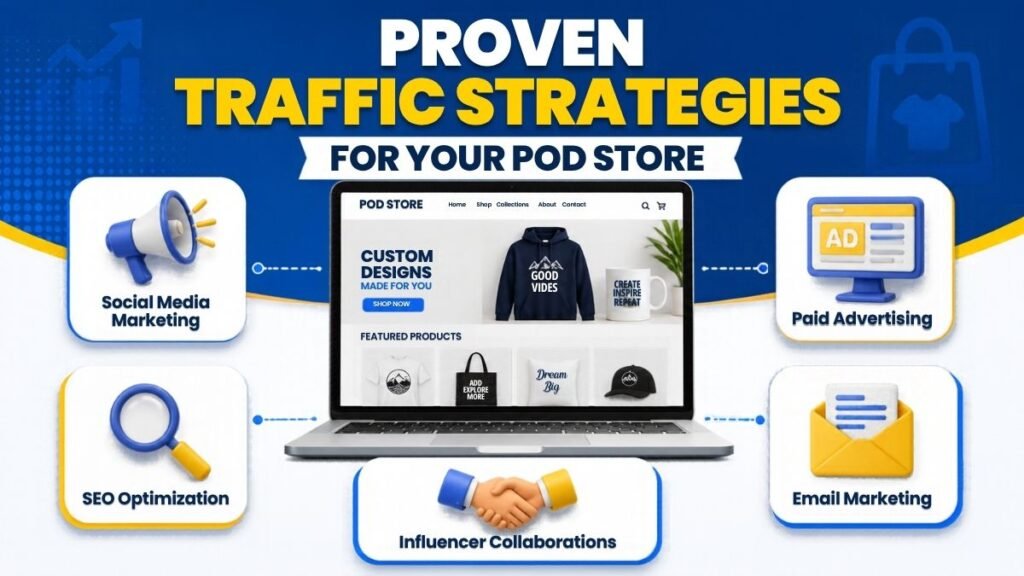
There are three important types of traffic:
Organic traffic: Visitors who discover your website through unpaid search results, Pinterest and other organic channels.
Social traffic: People who visit your store through social media posts, videos, communities and recommendations.
Paid traffic: Visitors who arrive through advertising campaigns on platforms such as Google, Meta and Pinterest, where available.
For beginners, building organic traffic is often a sensible starting point because it does not require paying for every visitor.
The objective is not simply to increase visitor numbers. It is to attract people who have a genuine interest in your products.

2. Understand Your Target Audience Before Marketing
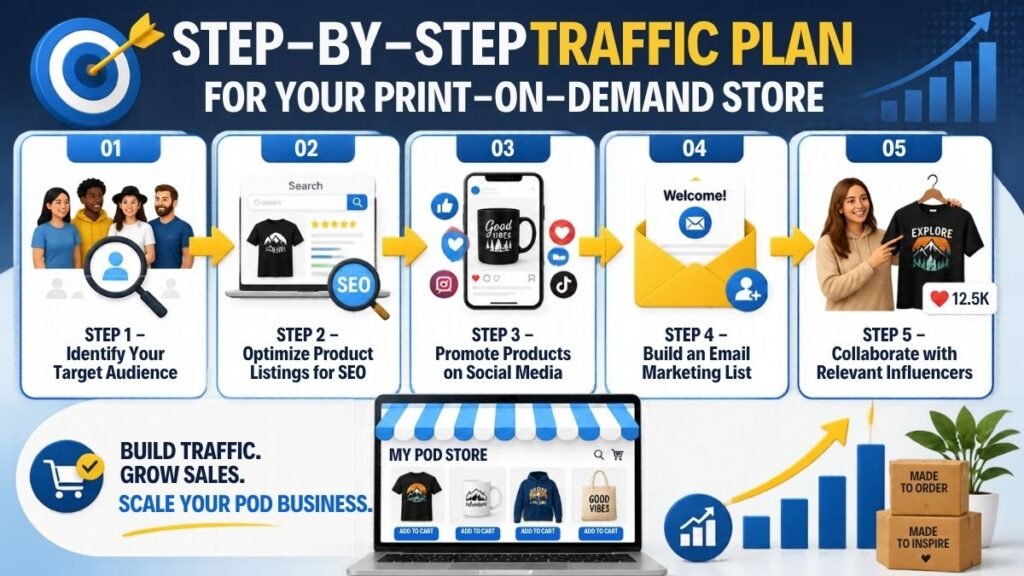
Before investing time in promotion, identify exactly who might purchase your products.
Trying to market everything to everyone makes it difficult to build a recognizable brand.
For example, a store selling personalized pet gifts should target people interested in pets, animal lovers and personalized presents rather than a completely unrelated audience.
Identify your ideal customers
Start by answering these questions:
- Who is most likely to purchase your products?
- What interests and hobbies do they have?
- What occasions encourage them to buy?
- What problems or preferences influence their purchases?
- Which websites and social platforms do they use?
Here are some examples:
| POD niche | Potential audience | Product ideas |
|---|---|---|
| Pet lovers | Dog and cat owners | Personalized mugs, shirts |
| Gardening | Garden enthusiasts | Tote bags, garden-themed gifts |
| Teachers | Teachers and educators | Mugs, stationery |
| Fitness | Gym enthusiasts | Workout shirts, bottles |
| Minimalist decor | Homeowners and renters | Wall art, cushions |
| Family gifts | Parents and relatives | Personalized apparel, keepsakes |
Focus on a specific niche
A focused store makes it easier to develop consistent designs, write relevant product descriptions and create marketing content.
For example, instead of selling random T-shirts, consider building a collection around:
- Funny dog owner gifts.
- Personalized family apparel.
- Minimalist motivational designs.
- Gardening-themed gifts.
- Profession-specific merchandise.
A clear niche also helps you identify relevant search terms and potential customers.
3. How to Drive Traffic to Your Print-on-Demand Store
here is no single traffic source that works for every POD business. A better approach is to test several channels, measure their performance and concentrate on the ones that bring relevant visitors.
Step 1: Use Pinterest Marketing to Attract Free Traffic
Pinterest is a visual discovery platform where users search for inspiration, product ideas, home decor, fashion and gifts.
This makes it particularly useful for print-on-demand businesses.
Unlike a typical social media post, a Pinterest Pin can continue attracting visitors long after its original publication.
How to use Pinterest effectively
- Create a Pinterest Business account.
- Complete your profile with a clear description of your POD niche.
- Create boards around specific product categories.
- Design attractive vertical Pins.
- Write keyword-focused Pin titles and descriptions.
- Link every relevant Pin directly to the corresponding product or collection page.
Example:
Suppose you sell personalized dog-themed T-shirts.
Instead of creating a generic Pin titled “New T-Shirt Design,” use a descriptive title such as:
“Funny Dog Mom T-Shirt – Gift Ideas for Dog Lovers.”
Your Pin should show the actual product clearly, use readable text and communicate why someone might want it.
Pinterest content ideas
- Product mockup images.
- Gift guides.
- Seasonal product collections.
- Design inspiration.
- Personalized gift ideas.
- Home decor styling suggestions.
Recommended approach: Start with a manageable publishing schedule, such as three to five useful, original Pins per week. Focus on quality and relevance rather than publishing large numbers of nearly identical Pins.
Step 2: Optimize Etsy Listings for Search Traffic
If you sell through Etsy, marketplace search optimization is essential.
Etsy shoppers frequently search for specific products, occasions, styles and recipient types.
Your listings should clearly communicate what you are selling.
Improve your Etsy product listings
A. Write clear product titles
Place the product name and its most important characteristics near the beginning.
Example:
“Personalized Dog Mom Sweatshirt, Custom Pet Gift”
Avoid filling the title with repeated keywords that make it difficult to read.
Etsy’s updated 2026 title guidance emphasizes clear, buyer-friendly titles, with important product details included naturally.
B. Use relevant tags
Etsy allows up to 13 tags per listing. Use accurate, varied phrases that describe the product, design, recipient and intended use.
Example tags for a dog-themed sweatshirt:
- Dog mom sweatshirt
- Pet lover clothing
- Custom dog gift
- Dog owner present
- Personalized sweatshirt
- Animal lover gift
Use all relevant tag opportunities without adding unrelated search terms.
C. Improve product descriptions
Include:
- Product type and design.
- Material and available sizes.
- Personalization options.
- Printing and fulfillment information.
- Shipping expectations.
- Care instructions.
D. Improve product photographs
Use high-quality mockups that show the product clearly.
Include multiple views, close-up details and lifestyle images where possible.
A customer should be able to understand the product without having to guess what it looks like.
Important: Etsy search considers more than the title alone. Listing attributes, tags, descriptions, photographs and other information also contribute to how listings are matched with shoppers.
Official resources:
- Etsy Seller Handbook: https://www.etsy.com/seller-handbook
- Etsy SEO guidance: https://help.etsy.com/hc/en-us/articles/115015663987
Step 3: Improve Shopify SEO
If you operate an independent Shopify store, search engine optimization can help potential customers discover your products through Google.
Unlike marketplace listings, your Shopify store needs its own search visibility and brand recognition.
Essential Shopify SEO practices
- Write unique product titles.
- Create detailed product descriptions.
- Use descriptive image alt text.
- Optimize product images for loading speed.
- Organize products into relevant collections.
- Use descriptive URLs.
- Add useful internal links between related products and blog articles.
- Make sure your website works properly on mobile devices.
Example product title:
Personalized Floral Ceramic Coffee Mug – Custom Gift for Her
Example image alt text:
White ceramic coffee mug with a personalized floral name design.
Avoid copying identical descriptions across multiple products. Explain what makes each product different.
Also check that your Shopify store has working navigation, contact information, shipping details, return policies and secure checkout.
Step 4: Use Google SEO to Attract Long-Term Organic Traffic
Google can be an important source of visitors for POD websites, especially when your content answers specific questions.
Instead of targeting only broad keywords such as “T-shirts” or “custom mugs,” explore more specific search queries.
Examples:
- How to choose a personalized dog gift.
- Best gifts for gardening enthusiasts.
- Minimalist T-shirt design ideas.
- How to create custom products online.
- Print-on-demand business ideas for beginners.
These topics help you attract people who are researching products or looking for solutions.
How to improve your website’s Google SEO
1. Research search keywords
Use tools such as:
- Google Keyword Planner.
- Google Search Console.
- Google Trends.
- Ahrefs Free SEO Tools.
- Semrush Keyword Overview.
Look for relevant search phrases, their intent and the competition you may face.
2. Create useful blog articles
Write articles that genuinely answer customer questions.
For example, a store selling gardening-themed products could publish:
“15 Gift Ideas for People Who Love Gardening.”
Include relevant product recommendations where they naturally help the reader.
3. Optimize headings
Use one clear H1 heading for the article title.
Organize the content using H2 and H3 headings.
Avoid repeating the same keyword unnecessarily.
4. Add internal links
Connect related articles, collections and product pages.
For example, an article about personalized gifts can link to your personalized mug collection.
5. Submit your sitemap
Use Google Search Console to submit your XML sitemap and monitor indexing.
For a WordPress website using Rank Math, the sitemap index is commonly available at:
https://yourdomain.com/sitemap_index.xml
Check your actual sitemap URL before submitting it.
6. Monitor indexing and performance
Google Search Console helps you understand:
- Which pages Google has indexed.
- Which search queries bring impressions.
- How many clicks your pages receive.
- Which pages need attention.
- Whether technical indexing issues exist.
Remember that submitting a sitemap or requesting indexing does not guarantee that Google will index or rank every page.
Step 5: Promote Products Through Social Media
Social media can help your products reach people who may not discover your store through search engines.
You do not need to maintain an active presence on every platform.
Choose channels that match your products and your available time.
Use attractive product photographs, Reels, Stories and relevant hashtags.
Content ideas include:
- New product collections.
- Product styling ideas.
- Design previews.
- Seasonal gift suggestions.
- Before-and-after mockup presentations.
Facebook can help build an audience through relevant pages, groups and product-related communities.
Share useful information rather than posting repetitive promotional links.
Follow each group’s rules before sharing commercial content.
TikTok and YouTube Shorts
Short videos can demonstrate product designs and communicate their appeal quickly.
Possible video ideas:
- Three personalized gift ideas for dog owners.
- How a simple T-shirt design becomes a finished product.
- Five creative mug designs for coffee lovers.
- Minimalist home decor ideas.
- Personalized gifts for Mother’s Day.
You can create faceless product videos using Canva, product mockups and simple animations.
Make the product visible immediately. Avoid lengthy introductions.
Marketing tip: Every social media post should have a purpose. It might introduce a product, answer a question, provide inspiration or direct interested viewers to a relevant collection.
Step 6: Use Content Marketing to Build Authority
Content marketing means publishing useful information that attracts people interested in your niche.
For a POD business, your blog can become a long-term traffic source.
Instead of writing only about your store, publish articles that help potential customers make decisions.
Examples of useful blog topics
| Blog topic | Potential audience |
|---|---|
| 20 Gift Ideas for Dog Lovers | Pet owners |
| Best Minimalist Designs for Home Decor | Home decor shoppers |
| How to Choose a Personalized Gift | Gift buyers |
| Popular T-Shirt Design Ideas | Fashion enthusiasts |
| Creative Teacher Appreciation Gifts | Teachers and parents |
| Personalized Gifts for New Parents | Family gift shoppers |
How to connect blog traffic with product sales
Imagine that you sell personalized mugs.
You could write an article titled:
“15 Personalized Coffee Mug Gift Ideas for Every Occasion.”
Within the article:
- Explain different types of personalized mugs.
- Discuss occasions when they make thoughtful gifts.
- Show relevant product examples.
- Link to your matching collection.
- Provide useful buying considerations.
This approach gives readers information while introducing products that match their interests.
Avoid writing articles that simply repeat information already available elsewhere. Add useful examples, original visuals, clear explanations and genuine product information.
Step 7: Build an Email Marketing List
Email marketing gives you a way to communicate with people who have voluntarily subscribed to receive updates.
Unlike social media followers, your email subscriber list is a marketing channel you can manage through an email service provider.
Ways to attract subscribers
- Offer a useful gift guide.
- Provide a discount where financially viable.
- Create a free design inspiration resource.
- Offer early access to new collections.
- Invite customers to receive occasional product updates.
What should you send?
A simple email strategy could include:
- Welcome email introducing your brand.
- New product announcements.
- Seasonal gift guides.
- Design inspiration.
- Occasional special offers.
Avoid sending too many promotional messages.
Make sure subscribers have clearly agreed to receive marketing emails, provide an unsubscribe option and follow applicable privacy and anti-spam requirements.
Step 8: Collaborate with Relevant Creators and Communities
Working with niche creators can introduce your products to an audience that already has an interest in your category.
For example:
- Pet product sellers can approach pet-focused creators.
- Gardening merchandise sellers can connect with gardening bloggers.
- Fitness apparel sellers can explore relevant fitness communities.
- Teacher gift sellers can approach education-focused creators.
Start with smaller creators whose audience genuinely matches your products.
Possible collaboration arrangements include:
- Sponsored product demonstrations.
- Affiliate links.
- Product reviews.
- Gift guides.
- Social media mentions.
Before offering free products or paying for promotions, agree on the deliverables and measure the results.
Do not assume that a large follower count automatically means a creator will generate sales.
4. Free Tools to Grow Your POD Traffic
You do not need to purchase several expensive marketing subscriptions when starting out.
A few well-chosen tools can help with keyword research, content creation, design and performance monitoring.
| Tool | How it helps |
|---|---|
| Google Search Console | Monitor Google search performance |
| Google Trends | Explore changing search interest |
| Google Keyword Planner | Research keyword ideas |
| Canva | Create Pins and product graphics |
| Pinterest Business | Publish and analyze Pins |
| Google Analytics 4 | Understand website traffic |
| Rank Math | Manage WordPress SEO |
| ChatGPT | Brainstorm content and marketing ideas |
| Microsoft Clarity | Understand visitor interactions |
How to use AI effectively
AI can help you:
- Generate blog topic ideas.
- Create initial product descriptions.
- Brainstorm social media captions.
- Develop Pinterest Pin titles.
- Organize keyword research.
- Prepare email drafts.
- Create content calendars.
However, review and edit AI-generated material before publishing.
Check product details, platform policies and factual claims. Add your own experience, examples and original information.
AI should assist your content creation process, not replace the effort required to produce genuinely useful information.
5. How to Convert Visitors into Customers
Getting traffic is only the first part of the process.
If visitors arrive but leave without exploring your products or making purchases, your store may need improvements.
Consider these conversion essentials.
Create a professional storefront
Your website should look trustworthy and be easy to navigate.
Include:
- A recognizable logo.
- Clear product categories.
- Professional product photographs.
- Easy-to-find contact information.
- Shipping and return policies.
- Secure checkout.
- A clear brand identity.
Improve product pages
Every product page should answer the customer’s basic questions.
Explain:
- What is the product?
- What material is it made from?
- What sizes or variations are available?
- Is customization available?
- How long does fulfillment take?
- What are the shipping and return conditions?
Use high-quality mockups
Product presentation has a significant influence on how visitors perceive your merchandise.
Use realistic mockups that show:
- The complete product.
- The design at a readable size.
- Different product angles.
- Relevant lifestyle settings.
- Available colors and variations.
Make sure the displayed product accurately represents the item customers will receive.
Make buying easy
Keep the purchasing process simple.
Avoid unnecessary pop-ups, confusing navigation and unexpected charges.
Clearly display the product price, shipping costs and important purchasing information.
Establish trust
Include accurate business information, customer support details and transparent policies.
Never create fake customer reviews or make unsupported quality claims.
Trust is especially important when customers are purchasing from an unfamiliar online store.
6. Common Print-on-Demand Marketing Mistakes
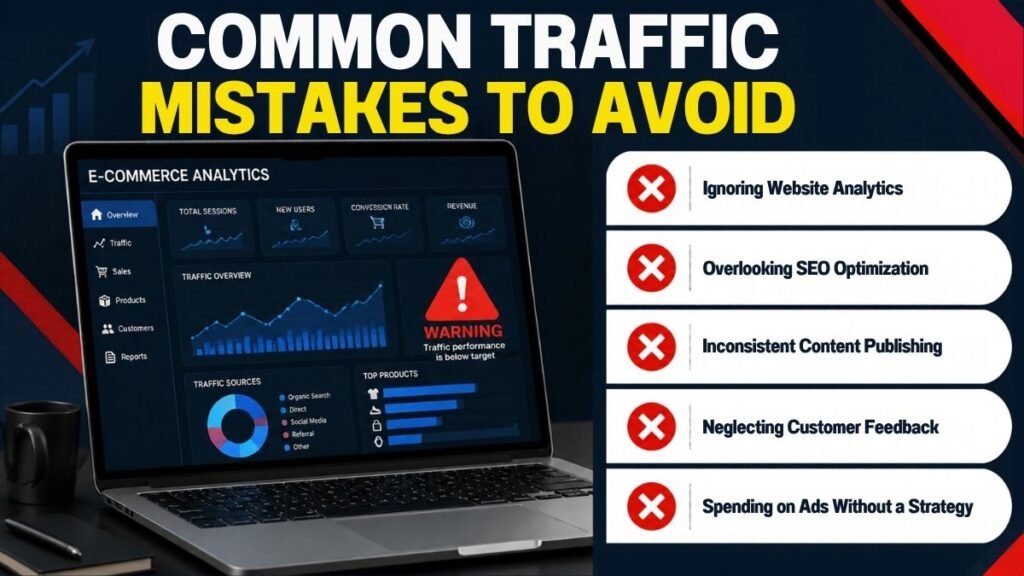
Many new POD sellers spend considerable time creating products but overlook the activities that help customers discover them.
Here are mistakes worth avoiding.
Mistake 1: Uploading too many products without a strategy
Having hundreds of designs does not guarantee sales.
Focus on product relevance, design quality, niche selection and customer demand.
Mistake 2: Targeting overly broad keywords
Keywords such as “shirt,” “mug” and “gift” are extremely broad.
Explore more descriptive phrases that reflect the actual product and customer intent.
Mistake 3: Using identical product descriptions
Each listing should accurately describe its product.
Avoid publishing the same generic description across an entire collection.
Mistake 4: Ignoring product photographs
Poor mockups can make even attractive designs look unappealing.
Use clear, realistic and consistent product imagery.
Mistake 5: Spending money on advertising too early
Paid advertising can generate traffic, but it does not automatically produce profitable sales.
Before spending money, check your product pricing, profit margins, landing pages and conversion process.
Mistake 6: Promoting products without understanding the audience
Posting random promotional material rarely creates a strong connection with potential customers.
Publish content that matches the interests of your intended audience.
Mistake 7: Ignoring analytics
Without tracking performance, it is difficult to identify which activities deserve more attention.
Use available analytics to make decisions rather than relying on assumptions.
Mistake 8: Expecting immediate results
SEO, content marketing and organic social media growth require time and consistent effort.
Evaluate progress over weeks and months rather than expecting every new post to produce immediate sales.
7. A Practical 30-Day POD Traffic Growth Plan
Instead of attempting every marketing technique simultaneously, follow a manageable plan.
This schedule is designed for a beginner or solo POD seller with limited time and a small marketing budget.
Week 1: Build a Strong Foundation
Day 1: Choose one primary product niche.
Day 2: Identify your target customer and research relevant search terms.
Day 3: Review your existing product listings and identify weak descriptions.
Day 4: Improve the titles and descriptions of five important products.
Day 5: Create better product mockups.
Day 6: Check your website navigation, mobile layout and product pages.
Day 7: Set up or review Google Search Console and Google Analytics.
Week 2: Start Organic Marketing
Day 8: Create a Pinterest Business account or optimize your existing profile.
Day 9: Create three niche-specific Pinterest boards.
Day 10: Design five original Pins.
Day 11: Publish the Pins with relevant descriptions and product links.
Day 12: Prepare three social media posts.
Day 13: Create one short product demonstration video.
Day 14: Review the initial engagement and improve weak content.
Week 3: Build Search Visibility
Day 15: Research five useful blog topics.
Day 16: Prepare one detailed blog article.
Day 17: Add relevant internal links to your article.
Day 18: Optimize the article’s title, headings and meta description.
Day 19: Check image sizes and alt text.
Day 20: Publish another group of original Pinterest Pins.
Day 21: Review your website’s indexing and search performance.
Week 4: Improve and Measure
Day 22: Review product page performance.
Day 23: Identify products receiving the most attention.
Day 24: Improve weak product photographs or descriptions.
Day 25: Create another useful social media video.
Day 26: Prepare a seasonal or niche-specific gift guide.
Day 27: Review Pinterest analytics.
Day 28: Review website traffic sources.
Day 29: Identify which marketing activities generated meaningful engagement.
Day 30: Prepare your next month’s marketing plan based on the results.
Important: This is an action plan, not a promise of sales or a guaranteed ranking schedule. Some activities may take longer to show measurable results.
8. How to Measure Your Traffic and Marketing Results
Traffic numbers alone do not tell you whether your POD business is growing.
You should understand where visitors come from and what they do after arriving.
Here are the most useful metrics to monitor.
| Metric | What it tells you |
|---|---|
| Organic clicks | Visitors from unpaid search results |
| Impressions | How often pages appear in Google results |
| Click-through rate | How frequently impressions generate clicks |
| Website sessions | Visits to your website |
| Traffic sources | Where visitors originate |
| Engagement | How visitors interact with your content |
| Add-to-cart rate | How frequently visitors add products |
| Conversion rate | Percentage of visitors who purchase |
| Revenue | Sales generated by your store |
Use Google Search Console
Check the Performance report regularly.
Look for:
- Search queries generating impressions.
- Pages receiving clicks.
- Keywords with high impressions but low clicks.
- Pages that have gained or lost visibility.
For example, if a blog article receives impressions but few clicks, review its title and meta description.
If it receives clicks but visitors do not explore your products, improve its content and internal links.
Use Google Analytics 4
GA4 helps you understand how people reach and interact with your website.
Pay attention to acquisition reports, landing pages, engagement and configured purchase events.
If you operate an online store, ensure that ecommerce tracking is configured correctly.
Calculate whether advertising is worthwhile
Before increasing an advertising budget, understand your contribution margin.
For example:
Suppose a product sells for $25.
- Product and fulfillment cost: $12
- Platform and transaction costs: $3
- Other variable costs: $2
- Amount remaining before advertising: $8
If acquiring a customer costs $10, that sale loses money before considering other business expenses.
This is why understanding product margins is essential before scaling paid campaigns..
FAQs: How to Get Traffic to Your Print-on-Demand Store (2026)
Q1. How can I get free traffic to my print-on-demand store?
Start with Pinterest, Google SEO, useful blog content, marketplace optimization and organic social media.
Choose channels that match your products and target customers. Focus on consistent, relevant content rather than publishing large amounts of promotional material.
Q2. Which platform is best for promoting POD products?
There is no universal best platform.
* Pinterest is useful for visual product discovery.
* Etsy offers access to shoppers searching within its marketplace.
* Google can bring long-term organic search traffic.
* Instagram and TikTok can help showcase products.
* Shopify gives you greater control over your independent storefront and brand.
Choose based on your niche, audience and business model.Driving organic traffic is possible with these strategies:
Q3. Can I get traffic to my POD store without paid advertising?
Yes. Organic search, Pinterest, social media, blog content and marketplace search can all help attract visitors without paying for advertisements.
However, free traffic still requires time, research and consistent work.
Q4. How long does it take to get traffic from Google?
There is no fixed timeframe.
New or updated pages may be discovered and indexed at different times. Ranking depends on many factors, including relevance, content quality, competition, website accessibility and overall search performance.
Do not assume that submitting a sitemap guarantees immediate rankings.
Q5. Is Pinterest useful for print-on-demand businesses?
Pinterest can be a useful discovery channel for visual products, gift ideas, fashion, home decor and personalized merchandise.
Use original images, relevant keywords and direct links to appropriate product pages.
Q6. Should I focus on one marketing platform or several?
Start with one primary traffic source and one supporting channel.
For example, you could focus on Pinterest while improving your Google SEO.
Once your process becomes manageable, test additional channels.
Q7. Should I run Google Ads for my POD store?
Only consider paid campaigns after reviewing your product quality, pricing, margins, website experience and conversion tracking.
Start with a small test budget that you can afford to lose. Evaluate actual purchases and profitability rather than clicks alone.
Q8. How many products should I upload to my POD store?
There is no ideal product count.
A smaller, carefully selected collection can be more effective than hundreds of unrelated products.
Focus on designs that serve a clearly defined audience and present them professionally.
Q9. Can AI help me promote my print-on-demand business?
Yes. AI tools can assist with keyword research, product descriptions, content planning, social media captions and design brainstorming.
Always review the output for accuracy, originality, product suitability and platform compliance.
Q10. What should I do if my POD store receives visitors but no sales?
Review your product prices, product photographs, descriptions, shipping charges, target audience and checkout process.
Also check whether the visitors are genuinely interested in your products.
More traffic will not necessarily solve a problem with product-market fit or conversion.
10. Final Thoughts: Build a Sustainable POD Traffic Strategy
Getting consistent traffic to a print-on-demand store requires more than uploading designs and waiting for customers.
You need to understand your audience, create relevant products, optimize your listings and publish useful content that helps potential buyers discover your brand.
Start with manageable activities:
- Improve your best product listings.
- Build an organic presence on Pinterest.
- Publish useful, search-focused blog articles.
- Optimize your website for Google.
- Create relevant social media content.
- Monitor traffic and customer behavior.
- Improve your store based on actual results.
You do not need to do everything at once.
Choose a focused strategy, test it consistently and invest more effort in the activities that attract relevant visitors and generate profitable sales.
Your next step: Choose one product category, identify your ideal customer and start building a traffic strategy around that audience.
A successful POD business is not just about creating more products. It is about helping the right customers discover products they genuinely want to buy.